Where is CPC Moving?
We got an email. I got curious.
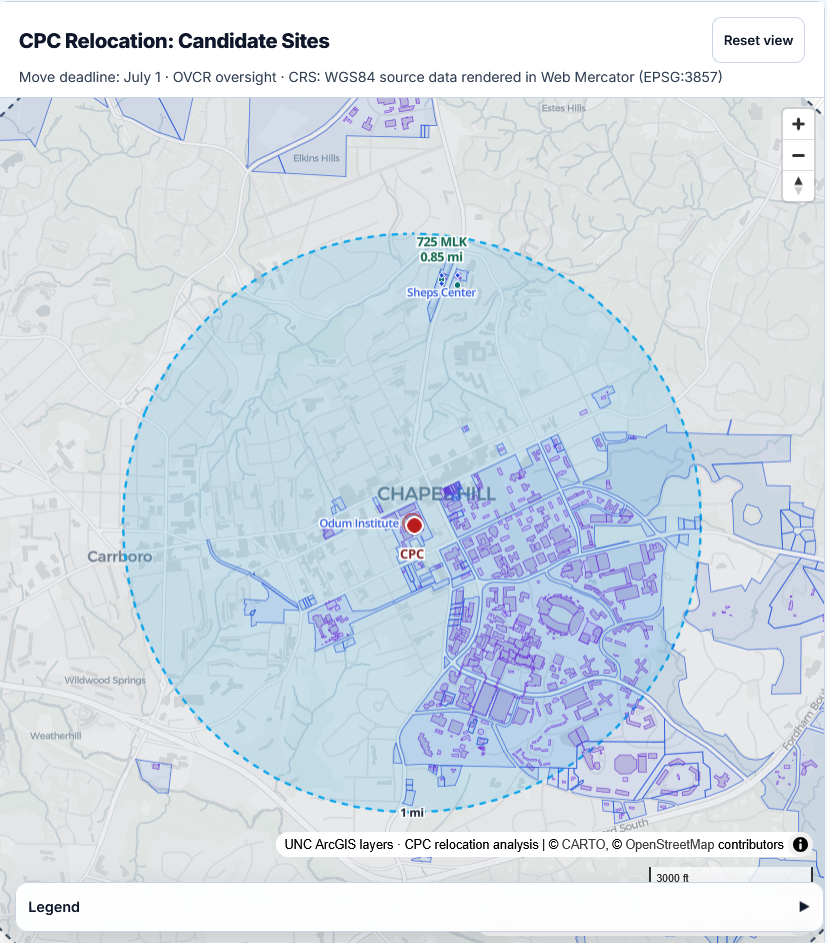
We got an email that CPC is moving. July 1. No details on where. I spend a lot of my day at Carolina Population Center, and a move changes everything — commute, parking, which collaborators you bump into, the general… energy.
So I started with this.
CPC falls under the Office of the Vice Chancellor for Research, which oversees 14 pan-campus research centers. I figured if I could see where the OVCR already puts its centers, I’d have a decent guess at where they’d put us.
Turns out there’s a pattern. The MLK Jr Blvd corridor is basically OVCR row — Sheps, IPRC, HSRC, HPDP, all within a few blocks. RENCI is out at Europa Center. We’re currently sharing Carolina Square with the Odum Institute and the Galapagos Studies folks.
Then I found that 720 MLK Jr Blvd — right in the middle of that cluster — was vacated by OHRE/IRB back in December 2023 and is just… sitting there. 9,350 square feet, UNC-owned, listed as available. That felt like a signal.
The map.
I pulled UNC building footprints and property boundaries from ArcGIS, plotted all the OVCR sibling centers, scraped some commercial listings, checked UNC Real Estate Operations for vacancy data, and layered it all together. Coordinates are geocoded from OpenStreetMap so markers line up with actual buildings. Hover over building footprints for names.
Green markers are the spots where the pieces already fit — existing OVCR presence, available space, UNC-owned. Orange markers are plausible but less certain. Carolina North got cut entirely because groundbreaking isn’t until 2027.
Thoughts
If I had to bet, it’s near Sheps on MLK. There’s an available space right next to three other OVCR centers, and it’s UNC-owned. Europa Center is the other strong candidate — RENCI’s already there, there’s tons of Class A office space — but it’s a commercial lease, which is a harder sell when you’ve got university property sitting empty a mile closer to campus. And I know RENCI’s pretty expensive.
I guess I could do things like isochrones of commute times based on different vehicles… Maybe that’s next. There’s a lot that geographers would probably do differently.
Reflecting on the vibe coding.
This attempt used a weird mix of agents end-to-end on a project — planning, research, code, writing. I used the plan mode to lay out the approach before any code got written, which helped a lot. The parts I enjoyed were the parts I’d want to keep doing: designing the project, deciding what questions to ask, tweaking the direction as things took shape. I didn’t even do much research, part of the process involved just planning out the scope of research. I totally see how review articles are getting increasingly automated, I hate that.
Where it gets murkier is the execution. I got away with not really knowing the assumptions behind a lot of the choices the agent made. Haversine distance versus geodesic versus driving distance — I know what haversine is, but I didn’t stop to think about whether it was the right choice here, or what other options I had. Same with the buffer radius math, the degree-to-km conversion at our latitude, the ArcGIS query structure. Those decisions got made, they were reasonable, but I didn’t make them. I just accepted/rejected them.
That’s the thing I’m still working out. The design felt like mine. The execution felt like a collaboration. But there were moments in the execution where I was along for the ride, and I want to get better at recognizing those moments and deciding whether that’s okay or whether I need to slow down and understand what’s happening.
No promises.